
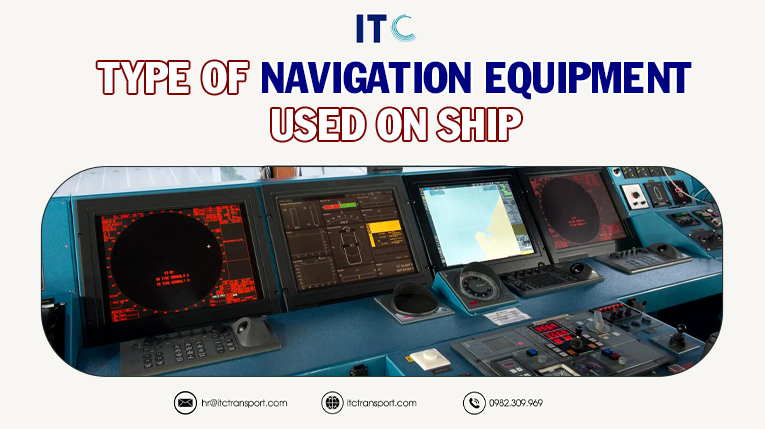
To ensure the safety and efficiency of voyage operations, modern ships are equipped with a wide range of navigation and communication systems. Below are the primary systems used on the bridge for maritime navigation:
1. RADAR (Radio Detection and Ranging)

RADAR is a system that uses radio waves to detect and locate objects such as ships, landmasses, and weather systems. By transmitting signals and measuring the echo return, RADAR determines the target’s distance, direction, and speed.
Functions:
-
Navigation and Collision Avoidance: Detects nearby vessels, land, buoys, and obstacles under low visibility conditions (fog, darkness, storms). Often integrated with ARPA (Automatic Radar Plotting Aid) for collision risk assessment.
-
Surveillance and Security: Continuously monitors surrounding waters to identify threats.
-
Weather Monitoring: Some radars can display rain squalls and storms.
-
Berthing and Maneuvering: Assists in precise navigation in congested ports or narrow channels.
2. ECDIS (Electronic Chart Display and Information System)

ECDIS replaces traditional paper charts with electronic nautical charts in compliance with IMO standards. It integrates data from GPS, Radar, AIS, and other sensors to provide a real-time and accurate navigational overview.
Functions:
-
Voyage Planning and Monitoring: Enables route planning and continuous tracking using up-to-date ENC (Electronic Navigational Charts).
-
Position Tracking: Displays the vessel’s real-time position on the chart.
-
Sensor Integration: Interfaces with Radar, AIS, Gyrocompass, and Echo Sounders.
-
Safety Alarms: Provides automatic alerts for shallow waters, coastal proximity, or hazardous zones.
-
Chart Updating: Automatically updates charts to the latest version.
3. AIS (Automatic Identification System)

AIS broadcasts a ship’s identity, position, speed, and course using VHF signals, allowing vessels to “see” each other on electronic displays—even without visual contact.
Functions:
-
Collision Avoidance: Displays surrounding vessels’ data to avoid collision.
-
Traffic Monitoring: Assists VTS (Vessel Traffic Services) in ports and traffic separation schemes.
-
Ship Identification: Provides name, type, destination, and navigational status.
-
Search and Rescue: Helps locate distressed vessels quickly.
-
Navigational Aid: Works alongside Radar and ECDIS to enhance situational awareness.
4. GPS (Global Positioning System)

GPS is a satellite-based system providing real-time positioning, velocity, and time data anywhere on Earth.
Functions:
-
Positioning: Displays accurate real-time coordinates (latitude, longitude).
-
Navigation: Guides the vessel along pre-set routes.
-
Speed and Course Monitoring: Indicates vessel’s course and speed over ground.
-
System Integration: Connects with Radar, AIS, ECDIS, Autopilot.
-
Time Synchronization: Provides precise timing for communication and data logging systems.
5. Gyro Compass

A gyro compass determines true north (not magnetic north) using a spinning gyroscope and Earth’s rotation. It is not affected by magnetic interference.
Functions:
-
True North Indication: More accurate for marine navigation.
-
Immunity to Magnetic Interference: Reliable even near metal structures or electronics.
-
Stability at High Latitudes: More accurate than magnetic compasses in polar regions.
-
Integration: Interfaces with Autopilot, Radar, and ECDIS.
6. NAVTEX (Navigational Telex)

NAVTEX is an automated broadcast system for maritime safety information such as weather forecasts, navigational warnings, and urgent messages.
Functions:
-
Maritime Safety Information (MSI): Delivers weather forecasts, coastal warnings, SAR alerts, and ice reports.
-
Automatic Reception: Messages are received without manual operation.
-
Area and Message Filtering: Allows selection by region or message type.
-
24/7 Operation: Continuously updates navigators with real-time info.
7. Magnetic Compass

The magnetic compass uses a magnetized needle to point to magnetic north and is a basic but essential backup system.
Functions:
-
Basic Navigation Tool: In use for centuries.
-
Magnetic North Reference: Subject to variation (declination).
-
No Power Required: Serves as an emergency backup.
-
Affected by Deviation: Needs regular calibration due to local magnetic interference.
8. Autopilot

The autopilot is an electronic system that automatically steers the ship along a predefined course.
Functions:
-
Maintain Heading: Based on compass or GPS input.
-
Reduce Officer Workload: Frees officers to focus on lookout duties.
-
Improve Fuel Efficiency: Avoids unnecessary rudder movement.
-
System Integration: Connects with GPS, Gyro Compass, ECDIS, etc.
9. Steering Control Systems

This system allows manual or automatic control of the rudder using the wheel or tiller. It includes control interfaces, hydraulic or electric actuators.
Functions:
-
Manual Steering: Helm or tiller controlled by a helmsman.
-
Automatic Steering: Linked with autopilot.
-
Command Transmission: Converts input to rudder movement.
-
Feedback Indicators: Shows rudder angle and system status.
-
Failsafe Mode: Manual override in case of system failure.
10. Echo Sounder

An echo sounder measures water depth by sending sound pulses from the hull to the seabed and calculating the return time.
Functions:
-
Depth Measurement: Prevents grounding.
-
Safe Navigation: Avoids shallow waters.
-
Seabed Mapping: Useful in hydrographic surveys.
-
Data Logging: Stores depth data for chart updating.
11. Speed Log

The speed log measures the ship’s speed and distance traveled through water (STW) or over ground (SOG).
Functions:
-
Speed Measurement: STW or SOG depending on the system.
-
Distance Traveled: Useful for fuel planning and voyage records.
-
Data Integration: Feeds information to ECDIS, AIS, Autopilot, and VDR.
12. VHF Radio (Very High Frequency)

VHF radios operate in the 156–174 MHz range and are the primary communication tool at sea.
Functions:
-
Ship-to-Ship / Ship-to-Shore Communication: Typically effective up to 20–30 NM.
-
Emergency Communication: Channel 16 is the international distress frequency.
-
Safety and Coordination: Used for harbor pilotage, navigational warnings, and collision avoidance.
13. BNWAS (Bridge Navigational Watch Alarm System)

BNWAS monitors the presence and alertness of the OOW (Officer of the Watch) and ensures bridge watchkeeping compliance.
Functions:
-
Watchkeeping Safety: Monitors officer activity and triggers alarms if no response.
-
Timed Activation Sequence: Includes alert escalation—from visual to audible alarms to master’s cabin alerts.
-
Emergency Alerts: Helps prevent incidents from fatigue or health issues.
-
SOLAS Compliance: Mandatory for vessels under IMO regulations.